Root canal treatment is used when the nerve tissue inside a tooth has become inflamed or infected. The aim is to clean and seal the canal system so the tooth can stay in function rather than being removed.
It has an unhelpful reputation, mostly earned decades ago. In practice it is a careful, unhurried procedure carried out under local anaesthetic, and most people find it comparable to having a large filling done.
Root canal treatment is usually considered when:
One pattern worth knowing: if severe toothache stops on its own, that often means the nerve has died rather than recovered. The tooth still needs assessing. There is more on that on our emergency page.
We start with an examination and x-ray, and explain what we have found before anything is decided.
Treatment itself is usually one or two appointments, sometimes three for a difficult molar. The tooth is numbed and isolated with a rubber dam, the canal system is cleaned and shaped, and a temporary filling is placed. At the final visit the canals are sealed and the tooth is restored.
Appointments run longer than a routine filling — often an hour or more — because the work rewards being unhurried.
Back teeth are where root canal treatment becomes more involved. A molar may have three or four canals, sometimes more, and their anatomy varies considerably between people. Canals curve, branch, and can narrow with age to the point where they are difficult to locate at all.
Dr Hill has a particular interest in root canal treatment and carries out molar cases here rather than referring them out as a matter of course. Where a tooth is likely to be better managed by a registered specialist, we will say so and arrange the referral.
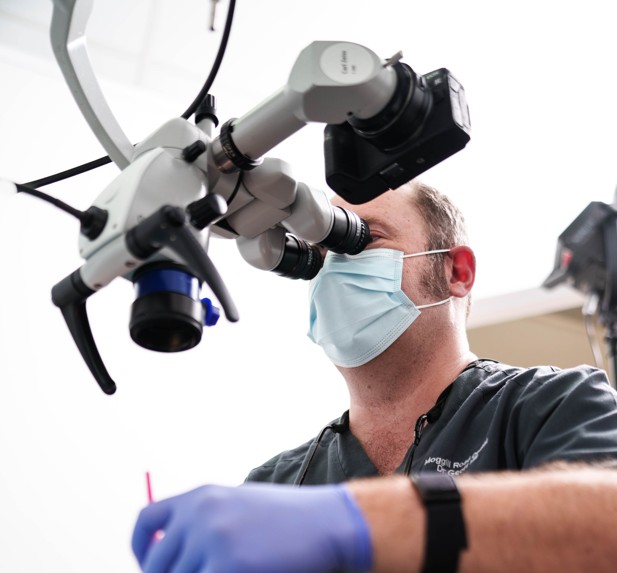
Much of this work is done using a dental operating microscope.
Magnification and coaxial light do not change the principles of the treatment, but they do change what can be seen — an unlocated canal, the extent of a crack, whether the pulp floor is intact, whether a canal has been fully cleaned. Fine cracks in particular are very difficult to see on an x-ray and often invisible to the naked eye.
The tooth is usually tender for a few days, especially to biting. Ordinary pain relief is generally enough.
A root-treated back tooth is more prone to fracture than an intact one, because both the original problem and the access cavity have removed structure. For that reason a crown or onlay is often recommended afterwards, particularly on molars and premolars. We will discuss whether that applies in your case, and when.
Both are legitimate options and it is worth understanding the trade-off.
Keeping the tooth avoids a gap, keeps the bone loaded and the bite stable, and is usually the less involved path. Removing it is quicker and cheaper on the day, but leaves a space that will generally need addressing later — with an implant, a bridge or a denture — at greater eventual cost and complexity.
Some teeth are not restorable, and where a fracture extends below the gum or too little tooth structure remains, extraction is the honest recommendation. We will tell you which situation you are in and why.
The fee depends on which tooth is involved, how many canals it has, how many visits it takes, and whether a crown follows.
You will have a written quote with item numbers before treatment begins, so you can check your entitlements with your health fund. We use HICAPS for on-the-spot claiming with all funds, and we are a preferred provider for Bupa, nib, HCF and Teachers Union Health.
The tooth is numbed thoroughly first. Most people describe the appointment as long rather than painful.
Usually one or two, occasionally three for a complex molar. We will give you an idea after the examination.
Many root-treated teeth function for years. Longevity depends on how much sound tooth structure remains, whether it is protected with a crown where that is indicated, and ongoing care.
Yes, and sometimes that is the sensible choice. We will go through both options and what each involves over time, including what replacing the tooth would mean.
Not every tooth does. Back teeth take heavy loads and a root-treated one has less structure left, so full coverage is often recommended to stop it flexing and fracturing. Front teeth can sometimes be restored more simply.
Not always. Dr Hill treats most molar cases here. Where a case would be better managed by a registered specialist — unusual anatomy, a retreatment, or a tooth with a complication — we will tell you and arrange the referral.
Yes. Local anaesthetic only, unless we have arranged something different with you beforehand.
Sometimes, in terms of timing or approach. Let us know at the appointment and we will talk it through, and liaise with your doctor where that is useful.
Yes — HICAPS on-the-spot claiming for all funds, and we are a preferred provider for Bupa, nib, HCF and Teachers Union Health.
Mon & Thu 8:30am – 7:00pm · Tue 8:30am – 2:30pm · Wed 8:30am – 4:30pm · Fri 8:30am – 2:30pm (alternate Fridays)
Taringa Professional Centre, Suite 9 / 180 Moggill Road, Taringa QLD 4068 — street level, easy to reach from Indooroopilly, Toowong and St Lucia.